

Getting started
How to Organise a Weekly Futsal Game in Singapore Without WhatsApp Chaos
 Sumit Pokhrel, Founder of Jum · 5 min read
Organising a weekly futsal game in Singapore? Learn how to manage players, RSVPs, teams, pitch expenses and payments without WhatsApp chaos.
Give the group one persistent home instead of a new WhatsApp thread each week, replace "who's in?" with a real RSVP and deadline, form teams from confirmed players before kickoff, and log the pitch fee the moment it's paid so settlement is a shared ledger, not a dozen separate transfers.

Photo: Lucas Andrade, Pexels
Organising a weekly futsal game sounds simple: book a pitch, ask who's playing, get enough players, play, split the cost. Anyone who's actually run a regular futsal group knows it rarely stays that simple.
"Who's playing this Sunday?" Then the notifications start. "Me." "I'm in." "Can't make it this week." "Add me." "Is there still a slot?" "Who's paid?" "How much do I owe?" Before long you're scrolling through a hundred messages just to work out who's actually coming — and that's before the pitch fee even gets mentioned.
Why a recurring futsal game gets harder than a one-off
A single futsal session is easy to pull together. A weekly one is a different job, because every week the organiser is re-solving the same list: player availability, the pitch booking, how many slots are left, RSVPs, last-minute cancellations, new players asking in, team allocation, and the pitch fee plus whatever else got bought along the way.
WhatsApp is genuinely good for talking to the group. It was never built to hold all of that. Important details get buried a few messages deep, and for a group that plays every week, reconstructing them by hand is real, recurring work — work a simple process can remove almost entirely.
One home for the group, not a new thread every week
The fix starts before the first game is even posted: give the group one place that persists, instead of a fresh WhatsApp conversation (or a scroll through an old one) every time a game gets organised. Regular players should always know where to look for who's in the group, when the next game is, how many spots are open, and who's already confirmed — without asking.
Stop asking "who's in?" in the chat
This is usually where a WhatsApp-run group gets messy. Instead of asking and manually tallying replies, let players RSVP directly — Going or Not Going — so the organiser sees the real headcount immediately. That matters most when the pitch has a fixed capacity: "19 going, 3 not going, 2 spots left" is something everyone can read in a second, instead of reconstructing it from a scrollback.
A registration deadline tightens this further. Once RSVPs close, the list is final, teams can be set, and anyone who missed the cutoff lands on a waitlist instead of repeatedly asking whether a spot's opened up.
Teams and game details, settled before kickoff
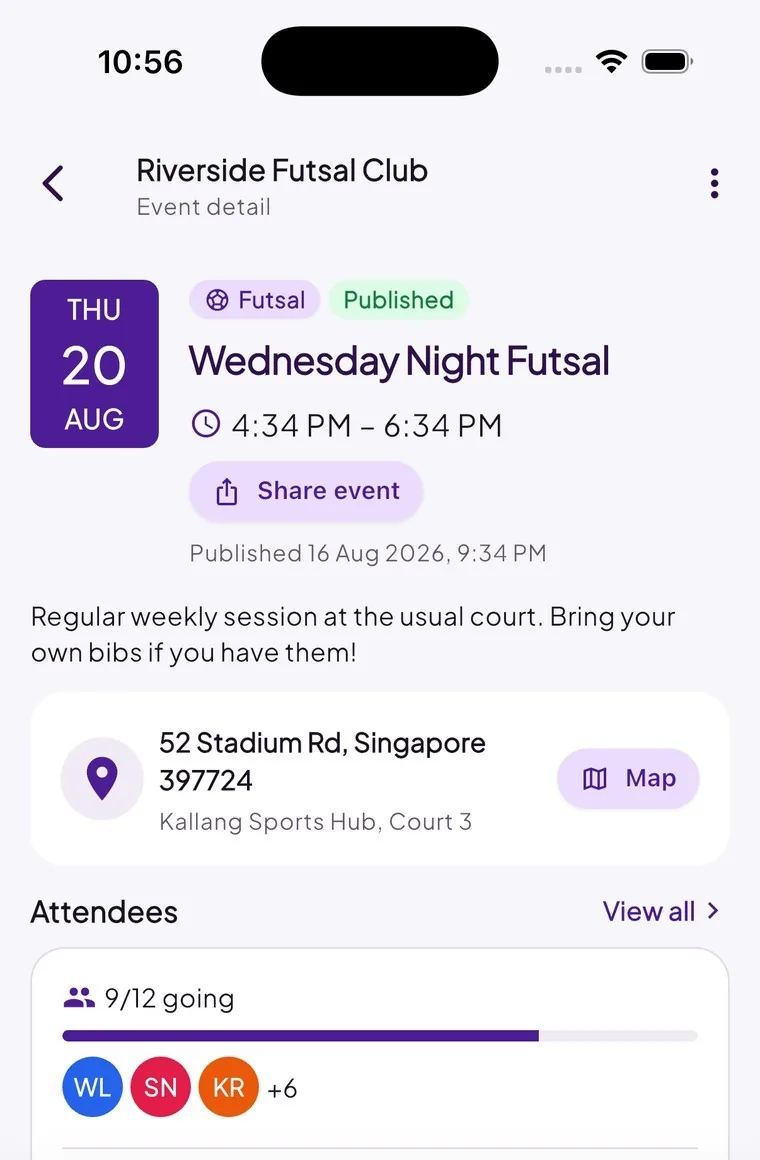
Once the confirmed list is locked, teams can be formed from the people who are actually coming — not a guess made the night before — and published where everyone can see their allocation before they arrive. No more working out who's on which side five minutes before kickoff. The event itself should carry everything a player needs on the day: venue, time, headcount, and their team, in one place instead of a half-remembered thread.
The game doesn't end when the whistle does
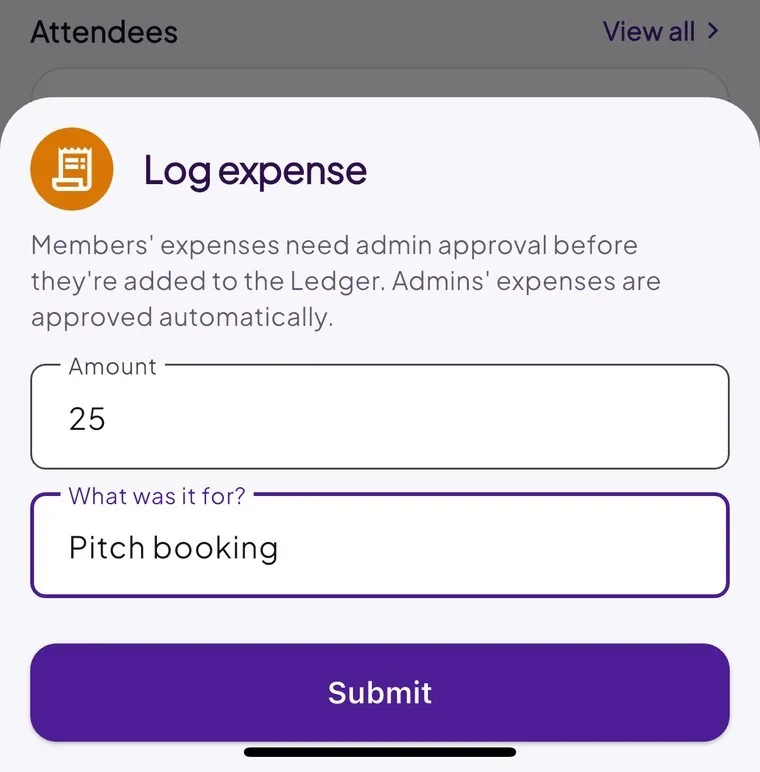
Someone always ends up fronting the pitch fee, and sometimes a round of drinks or ice on top of it. If one person pays $120 for a 20-player session, that's $6 a head — simple arithmetic, but only once you know exactly who was there. Recording the expense as part of the game, rather than reconstructing it afterwards, means the split happens automatically against the people who actually showed up.
Settlement is the other half organisers underestimate. Remembering who's paid, who paid cash versus who transferred, and chasing the stragglers is its own small job every week. A shared ledger where players can see what they owe and mark it paid — and the organiser can verify it — replaces that job with a glance.
A weekly futsal game becomes one recurring event inside your community: RSVP with a live headcount and automatic waitlist, teams formed from confirmed players and published before kickoff, the pitch fee logged and split the moment it's paid, and a shared ledger everyone can check instead of a scroll through old messages.
Do you still need WhatsApp?
Yes — just not for everything. WhatsApp still does what it's good at: banter, photos, match-day chat, staying connected with the group. What it isn't good at is being the database for the group itself. Keep WhatsApp as where you talk, and let a dedicated event hold the headcount, the teams and the money — trying to make one tool do both jobs is where the chaos usually starts.
Starting your own weekly futsal group
If you're thinking about starting one from scratch, you don't need a large community on day one. Pick a regular day and pitch — consistency is what makes people remember and plan around it — set a player limit, and invite your first group from friends, colleagues or existing sports contacts. Keep the rules simple and stated up front: how cancellations work, how the waitlist works, how expenses get split. The goal isn't one great session. It's making it easy to play every single week.
Jum grew out of exactly this — a real weekly futsal group in Singapore, run for years on WhatsApp messages and a spreadsheet someone had to update by hand. Less chasing, less scrolling, less spreadsheet. More playing.
Quick questions
How do I organise a weekly futsal game without it running entirely on WhatsApp?
Give the group one persistent home instead of a new chat thread each week, replace manually counting "who's in" replies with a real RSVP and a registration deadline, form teams from the confirmed list before kickoff, and log the pitch fee the moment it's paid.
How should a futsal pitch fee be split among players?
Log the total cost against the session and divide it across whoever actually showed up that week, not a fixed assumed headcount — the same fee split five ways one week and eight the next needs recalculating every time.
Do I need to stop using WhatsApp to run a futsal group well?
No — keep WhatsApp for banter, photos and match-day chat. The part worth moving elsewhere is the group's actual state: headcount, teams, and who's paid, which a plain chat log was never built to hold reliably.
See the full RSVP-to-settlement flow → Explore every feature →