

Getting started
Sports Groups in Singapore: How to Find, Join & Organise Games
 Sumit Pokhrel, Founder of Jum · 5 min read
Futsal, badminton, pickleball, basketball, running — Singapore has no shortage of sports groups. Here's how to find one, and how to organise one without it running on WhatsApp alone.
Sports groups in Singapore span futsal, badminton, pickleball, basketball and running, and most are still organised entirely over WhatsApp. A well-run group just needs five things: a clear event, a real RSVP, a way to form teams, shared expense tracking, and a simple settlement step after the game.

Photo: Kampus Production, Pexels
Singapore has no shortage of ways to stay active. Weekly futsal and five-a-side football, badminton sessions, the pickleball boom, basketball runs, weekend jogging groups — there's a group for almost anything, and a court or park within reach of most of the island.
Finding a sport to play is rarely the hard part. Running the group around it is. Who's actually coming this week? How many players do you have, and how many spots are left? Who needs adding to a team? Who fronted the money for the court, and who still owes for it? For most sports groups here, all of that still happens in a WhatsApp thread, a poll, and a payment reminder someone has to type out by hand.
What counts as a sports group?
A sports group is simply a group of people who get together regularly to play. Some form around a circle of friends, colleagues or a neighbourhood; others are open communities where new players can turn up and join in. The format changes, but the organising problem is the same one every time — getting the right people to the right place, and keeping track of everything that happens around the game itself. The most common shapes in Singapore:
- Futsal and football groups. A weekly pitch booking, an RSVP list, teams picked on the day, and a pitch cost split between whoever showed up.
- Badminton groups. Recurring court sessions with a headcount that changes week to week, and court time shared or rotated between games.
- Pickleball groups. Singapore's fastest-growing court sport right now — casual open play with a roster that's rarely the same twice (we've written more on organising pickleball open play specifically).
- Basketball groups. Pickup runs at a neighbourhood court, usually informal, but still needing a real headcount before anyone knows if there's enough for a full game.
- Running groups. Less about court bookings, more about keeping everyone informed of the next route, time and meeting point.
Whatever the sport, the pattern repeats: as soon as a group grows past a handful of regulars, the organising starts costing someone real time every single week.
Where WhatsApp breaks down
WhatsApp is genuinely good at conversation. It was never built to be the system that runs a recurring group.
Picture a typical Sunday game. Someone asks "who's playing this week?" and the replies start trickling in. Someone starts a mental list. Someone else drops out. A new person asks to join. Then, closer to kickoff: "how many spots left?" After the game, it's "who paid for the pitch?", and eventually, "can everyone send me $8.50?"
None of that is a WhatsApp problem exactly — the conversation works fine. The problem is that the actual state of the group — who's coming, who's on which team, who's paid — lives buried somewhere in a scrollback nobody wants to dig through, and one person ends up reconstructing it from memory every week.
What a well-run sports group actually needs
Strip away the specific sport, and a group that runs itself without a dedicated organiser needs five things to be true at once:
- A clear event — date, time, venue, how many spots are open, and when registration closes, visible to everyone without asking.
- A simple RSVP, so the organiser knows the real headcount instead of estimating from who "usually" shows up. If the game fills up, a waitlist handles the overflow automatically.
- A way to form teams from the people who actually confirmed, not from a guess made the night before.
- Shared expense tracking, so whoever pays for the court or pitch can log it in the moment instead of trying to remember the number two days later.
- A settlement step after the game, so everyone can see their share of the cost and mark it paid, instead of a dozen separate bank transfers each needing their own confirmation.
How to organise a weekly sports game
Whether it's futsal, badminton, pickleball or a running group, the same simple sequence works: create one home for the group instead of rebuilding it from scratch every week, open the next game with a date, time and venue, collect RSVPs so the headcount is real before anyone shows up, form teams once registration closes, play, log whatever gets paid for on the spot, and settle up afterwards so nobody's left chasing a transfer days later. The game itself is the only step that should take any real effort — everything around it shouldn't.
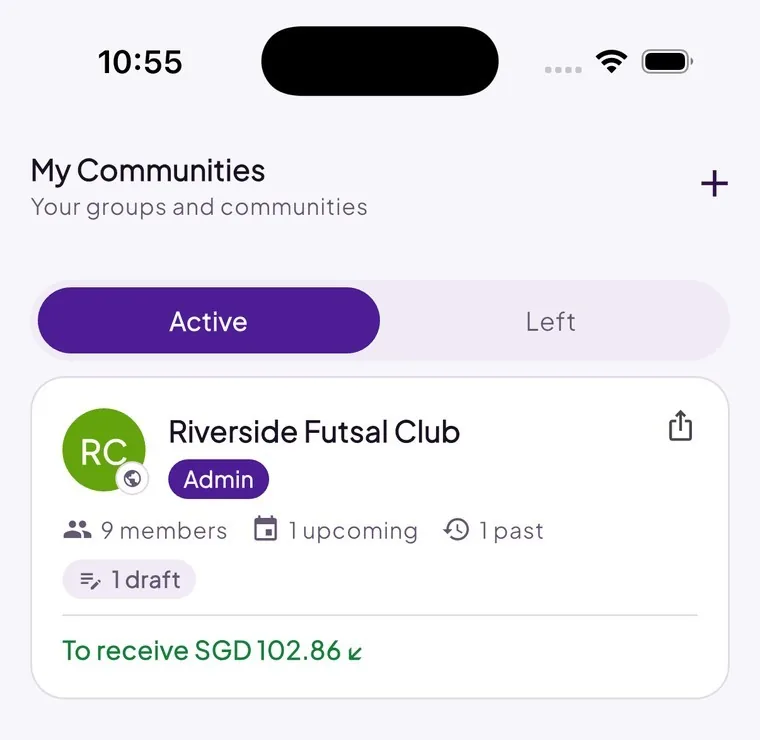
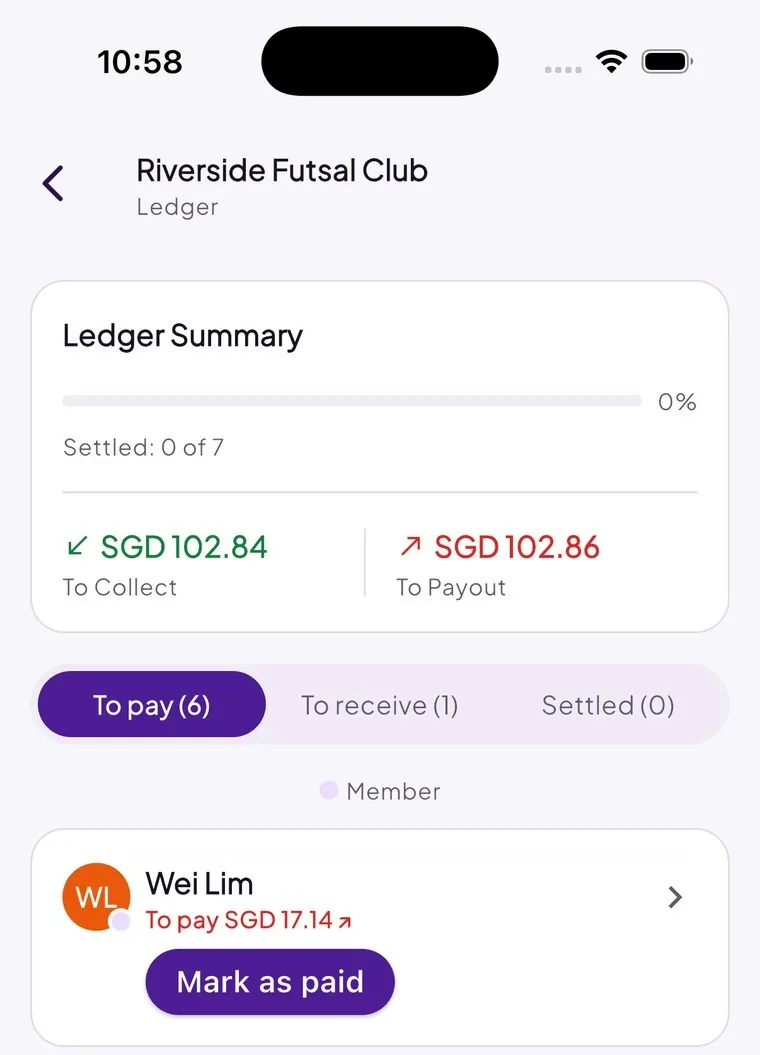
Jum brings the whole sequence into one place — community, event, RSVP, teams, play, expenses, settlement. Create the community once, then every week is just a new event inside it: members RSVP with a live headcount, teams get formed from confirmed attendees, whoever pays for the court logs it on the spot, and settling up is one shared ledger instead of private transfers each needing a "got it, thanks" reply.
Is Jum a replacement for WhatsApp?
Not really, and it doesn't need to be. WhatsApp still does what it's good at — banter, announcements, sharing plans with friends. What it was never good at is holding the actual state of the group: who's playing, how many spots are left, who's on which team, what's been paid, and who still owes. That's the part a running app should carry instead.
Think of WhatsApp as the conversation, and the app as the place where the game actually gets organised.
Jum grew out of a real weekly futsal group here in Singapore, run for years through WhatsApp messages and a spreadsheet that someone had to update by hand. Whatever sport your group plays — and however it's currently being organised — the goal is the same one that started this: spend less time chasing RSVPs and payments, and more time actually playing.
Quick questions
What are the most popular sports groups in Singapore?
Futsal and football, badminton, pickleball, basketball and running groups are the most common — the format differs, but every one of them runs into the same headcount, teams and cost-splitting problem once it grows past a handful of regulars.
Is WhatsApp enough to organise a sports group?
It's fine for conversation, but it was never built to hold the group's actual state — who's coming, who's on which team, who's paid. Most groups eventually add a dedicated tool for that part while keeping WhatsApp for banter.
What does a sports group need to run itself well?
Five things: a clear event with a real capacity and deadline, a simple RSVP so the headcount is accurate, a way to form teams from confirmed attendees, shared expense tracking, and one settlement step everyone can see instead of private transfers.
See the full RSVP-to-settlement flow → Explore every feature →